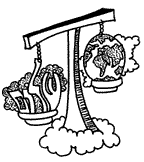
"I will grant
peace in the land so that you will sleep without fear. I will
rid the land of dangerous animals, and the sword will not pass
through your land." (Parshat Bechukotai 26:6)
When you piece
together all the Brachot (blessings) Hashem promises
in exchange for keeping His Torah, you've got to wonder
why it all winds down to one final Bracha of "peace."
Our Rashi says that by ending all the Brachot with
that of Shalom, the Torah teaches us that Shalom
is a "mega-bracha," equivalent to all the other Brachot
combined.
Shalom
outweighs all the other good in the world. Without Shalom,
there is no good.
Birchat Kohanim,
the Priestly Blessing, ends with Shalom: "May Hashem
lift up his face to you and give you peace" (Bamidbar, Parshat
Nasso 6:26). This teaches us that a Bracha is nothing
if it does not contain "Shalom."
Similarly, the
Amidah, which contains 19 brachot, ends with the
word "Shalom."
Making peace is
so great that one may even erase Hashem's name in the
ritual of the sotah (Bamidbar, Parshat Nasso 5:23),
in order to make peace between a man and his wife.
Rabbi Meir was
once lecturing all Saturday night. A woman was listening to
the speech and remained there until Rabbi Meir had finished.
By the time she got home, it was already morning.
"Where have
you been?" asked her husband.
"At the Rabbi's,"
she answered, "listening to a lecture."
The husband was
furious. He swore that he would not let her come into the house
until she spat in the rabbi's face. The woman remained outside
the house for three days. She could not do what her wicked husband
had told her.
"Why are you being
so stubborn?" her neighbors asked her. "The best thing we can
do is go to Rabbi Meir for advice." As soon as Rabbi Meir saw
them he knew by Divine inspiration what had happened. Rabbi
Meir needed to find a way to bring peace between this woman
and her husband without embarrassing her along the way.
So what did Rabbi
Meir do? He suddenly put a hand over his eye and moaned in pain.
In those days, spells and charms were as common as tylenol is
today. The obvious cure for an aching eye was a blast of expectorant.
"Does anyone of you know how to cast a spell on my eye?" the
great sage cried out.
The woman's neighbors
said to her, "Now you can do what your husband asked. When you
cast the spell, you can spit in his face. This is what is usually
done when such a spell is cast."
The woman sat
down to spit in his face, but she still did not have the audacity
to do it; she was in such great awe of Rabbi Meir.
"Pardon me, Rebbe,"
she said, "I am not an expert in charms."
"It does not matter,"
said Rabbi Meir. "Spit in my face seven times and I will be
healed."
She spat in his
face seven times. Rabbi Meir then said to her, "Go to your husband
and tell him 'You told me to spit once, but I spat seven times.'
"
After the woman
left, Rabbi Meir's disciples asked, "Was it proper to degrade
yourself and the honor of the Torah in such a manner?
You could have told one of us to recite the incantation."
"Let Meir's honor
not be greater than the honor of his Master," replied the Rabbi.
"Hashem's great Name is written in holiness and still
the Torah says it should be obliterated to bring peace
between a man and his wife. Meir's honor is no greater than
this."
Aharon, the first
Kohain Gadol, was a lover of peace. That is why, when
Aharon died, all Israel wept for him, even women and children,
as it is written, "The entire house of Israel wept for Aharon
thirty days" (Bamidbar, Parshat Chukat 20:29).
When Aharon died,
80,000 young children went to his funeral. All of them were
named Aharon. This was because, whenever a man wanted to divorce
his wife, Aharon would come and make peace between them. The
husband and wife would then be reconciled. When the woman gave
birth to a son, they would name him Aharon, since Aharon had
brought about his birth.
The opposite of
peace is strife. To understand the power of peace look at the
ugliness of strife and see what gain exists for those who engage
in it.
Korach engaged
in strife and he and all his associates died a horrible death,
being swallowed up by the ground. This was something that never
happened to anybody else. The Mann was interrupted that
day; that had never happened before, even when the Eigel
Hazahav (the Golden Calf) was made. Young babies died because
of them. Everything that they had owned was swallowed up, even
as trivial an item as a needle.
From here we see
how terrible strife can be. It is disgusting in Hashem's
eyes. Peace is a much better alternative.
|