Here we are in the middle
of the holy Yom Kippur Avodah when suddenly Bitachon
(faith) is dealt a doubt with the introduction of "Azazel."
Who is this mysterious Azazel?
The first thing you need to know about this Azazel ritual is that it
is a Chok, a law shrouded in deep mystery.
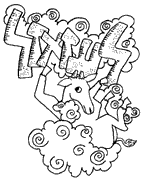
Two he-goats are chosen. Two lots are placed into a box. One says
"L'Hashem," the other says "L'Azazel." The Kohain Gadol closes his eyes, takes one lot in each hand and places one hand over each of the two he-goats. The
"L'Hashem" goat is sacrificed in the Bait Hamikdash. The "L'Azazel" goat is sent running until it meets its bloody end toppling off
a cliff and smashed on the rocks below. Why? It's one of those Mitzvot
Hashem has commanded us with no explanation.
With blind faith out of the way, the Sages offer a few explanations of
their own:
One explanation tackles "Azazel" from the root. Root
of the word, that is. According to the etymological interpretation,
"Azazel" is the combination of two words: "Azaz,"
meaning "strong" and "el," meaning "mighty." It's all
very simple: the rocks at the bottom of the cliff are "strong"
and "mighty," so "L'Azazel" means "to the rocks."
Need a more tell-tale interpretation? Okay... Once upon a time, when the
world was young and wicked, there were a couple of Malachim (angels) who begged
Hashem to let them live among mankind. They swore up and down that they
could resist the temptations of man's ways and would be great tzadikim.
Well, Hashem knew better but He stamped their passports anyway. The two
Malachim handed in their wings and headed to earth.
As the story goes, these Malachim were "no angels." As a matter of fact,
they broke every rule in the book. They became the official poster boys
of the mabul (flood). Here's the kicker. You want to know their names?
"Aza" and "Azael," of course! So, according to this interpretation, the
he-goat is code-named "Azazel" to remind us that this ritual will atone
for even the most immoral sins, like those committed by the two fallen
angels, Aza and Azael.
Then there's the interpretation for those who need a little Satan in their
lives: It's simple: Azazel is Satan! And there's a story
to go along with it too:
It seems that on the Seventh of Sivan, 2448, as the Jews were about to
receive the Torah, Satan came sulking to Hashem. "Oh, sure, I get to report the sins of the seventy nations of the world. But what meaning does my life have unless I can also spy on the Bnei Yisroel?" Hashem proceeded to make a deal with the devil. "Sure, you can spy on Bnei Yisroel all you want, but only on Yom Kippur." Now, that sounded like an okay deal to the Satan. But just as they were about to shake on it, Hashem added one condition.
"You can only make those accusations IF you find a sinner among the
Jewish people on that day."
True, Yom Kippur is a day of atonement and most Jews would be on their
best behavior, but somewhere there is bound to be an evil thought or
rebellious action among the Jewish people. That's where the he-goat to
Azazel comes in. It sort of plays a mind game on Satan.
In Hebrew, the word for he-goat is "sair." The same
word can also mean "hairy." This symbolizes Aisav,
the evil twin of Yaakov who was covered with hair. On
Yom Kippur, Hashem blames the sins of Klal Yisroel
on "the hairy one," Aisav. Aisav represents all the nations
of the world who pressure us in Galut (exile) to abandon
our Torah.
Whatever interpretation captures your fancy, Azazel
remains a true mystery in the X-files of Torah rituals.