 |
 |
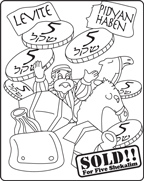
Sefer (the book[of]) Bamidbar is known in English as the "Book of Numbers," and with good reason. Hashem makes it a habit of counting the Jewish people over and over. And so, in this first Parsha of the "Book of Numbers," Hashem is back for the count as Moshe is commanded to count the Jewish people another time, and as Rashi explains, "Hashem counts the Jews because they are precious to Him." Our sages also refer to Sefer Bamidbar as the 'Chumash Hapekudim,' - 'the Book of Counting,' which can be loosely translated as the 'Book of Numbers.' It is called 'Chumash Hapekudim' because Klal Yisroel is counted twice in this Sefer. Once, at the beginning of this Parsha - Bamidbar, and once again in Parshat Pinchas. The first time the Jews were counted was when they traveled to Mitzrayim (Egypt) - the number given is 70. When they left Mitzrayim the number grew to 600,000. Once again, on the eleventh of Tishrei 2448, after the sin of the Eigel Hazahav (Golden Calf), Hashem counted them by means of a half shekel to determine how many were left after the sinners died. This time, on the first of Iyar, 2449, it is seven months after the second count. Hashem commands Moshe to count all of the tribes except for the tribe of Levi. That's because this count was only for the people who were destined to die in the Midbar because of the sin of the Golden Calf. Since the Leviyim stood in opposition to the idol worship, Hashem considered them "the king's special legions." Levi was chosen to serve in the Bait Hamikdash in the place of the first-borns, who were originally designated to perform the service. Hashem declared, "The Leviyim made themselves close to me, and I will be close to them." When Hashem finally commands Moshe to count the Leviyim, in the second count of this Parsha, the new criteria for counting is "..males from a month old upward." The Torah says that, "Moshe numbered them according to the word of Hashem." Moshe asked Hashem how could he possibly go into tents to count the babies. "No problem," Hashem responded, "you do your part, and I'll do Mine." Every time Moshe approaches a tent, a heavenly voice calls out the number of male Levite infants inside. The count is 22,000. That leads to a third count. This time, all the firstborns of Bnei Yisroel one month old and up. Moshe comes up with 22,273 first-borns. Now Hashem is ready to make the switch between firstborns and Leviyim official. There are 22, 273 firstborns. There are 22,000 Leviyim. Hashem makes an even switch, a firstborn for a Levi. This leaves 273 firstborns to contend with. Hashem tells Moshe that these 273 firstborns should each give five shekalim to redeem themselves from the service in the Mishkan. This money is to be given to Aharon and his sons. Moshe is faced with a dilemma. "How do I do that? If I ask the remaining 273 first-born to give 5 shekalim each, they will say to me, 'How do you know that I am part of the group of 273 first-born? I was already redeemed by a Levi, and exempt from this levy (no pun intended) of 5 shekalim.' " What did Moshe do? All together, those 273 first-born paid up 1365 shekalim. As Hashem had instructed, Moshe passed this money on to Aaron and his sons. This is where the law of "redeeming a first-born son" with 5 Shekalim, as discussed in Shmot Parshat Bo, originates. It is called "Pidyon HaBen." Why 5 Shekalim?
Incosistancy Resolved The Talmud relates
the following story:


Designed by R.A. Stone Design Associate and HI-TECH Computers, Inc. (718) 253-9698 Email.....info@hitechcomputers.com Page last updated - 05/18/2025 |
||||||||

Google ads
partially offset the costs of this site.
Email us ASAP with the URL of any
inappropriate ads, and we will request that they be
removed.