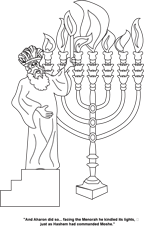
The Torah
tells us, "And Aharon did so... facing the Menorah he kindled
its lights, just as Hashem had commanded Moshe." (8:3)
Why would the Torah
praise Aharon for doing what he is supposed to? And, if it is
a point of praise, is that all the Torah can say in praise
of Aharon? After all, it doesn't take much to do what you're told…
or does it?
The Sfat Emet
explains that the first time a person performs a Mitzvah,
he has a natural tendency to do it with excitement. But as he
repeats the Mitzvah again and again, the excitement begins
to fade. The repetition can lead to boredom. Yet at the end of
his life, Aharon, who lit the Menorah every single evening for
39 years, was as enthusiastic with lighting the Menorah on his
last day as he was on the first. He never changed his attitude.
The holy Avodah of Aharon Hakohain was never done
out of routine or habit but with a new, fresh excitement every
single day.
Rabbi Meir
of Premishlan teaches us another great thing about Aharon. Although
Aharon was given the lofty position of Kohain Gadol, which
brought him very close to the Shechina, his personality
did not change. He didn't become arrogant, but remained with the
same level of humility. He "loved peace and ran after peace,
he loved all people and brought them close to Torah."
Aharon never changed his special way of dealing with all people
- he remained humble and modest and the lofty crown of Kehunah
Gedola that was placed upon his head never changed him even
one bit.
There is another
lesson in telling us that Aharon did exactly as he was told.
A king once sent
his minister to a banquet given by the neighboring king. He ordered
the minister not make any bets.
At the banquet,
one of the guests introduced himself and in the course of the
conversation said, "I know that you have a birthmark on your
back."
"That is not
true," retorted the minister. "I don't have any birthmarks
on my back!"
"How can you
deny something which everyone knows about."
"But that is
simply not true," the minister answered angrily.
"How about
if we made a bet. I will give you 10,000 silver coins if I am
wrong!"
Although he was
told not to make any bets, the 10,000 coins were very appealing.
He thought to himself, "After all, it is a sure bet, for
I know that I don't have any birthmarks. I will give the 10,000
silver coins to the king, then for sure he will be happy I didn't
listen to him and made the bet."
He removed his shirt
showing that he had no birthmarks! The other guest apologized
and gave him the 10,000 coins.
Upon returning to
his country, he couldn't wait to tell the king of his experience.
He gave the king a report of his mission and handed him a bag
full of silver coins.
"What is this?"
the king wondered. He told him about the bet he made.
"But I told
you not to make any bets!" The king retorted angrily.
"Your majesty,"
replied the minister, "I didn't think you would mind as I
knew for sure that I would win the bet and bring you 10,000 silver
coins!"
"You fool!"
said the king in dismay. "Before I sent you I bet 50,000
silver coins with the king of that country that they would not
be able to get you to make a bet. This is why I warned you not
to make any bets. What value is your 10,000 coins when I have
just lost 50,000 silver coins because of your bet!"
The moral and lesson
of the story is that a person must not change any of the commandments
of the Torah. Even if it may seem that the changes are
for the better. For only Hashem knows the true reasons
and effect of the Mitzvot.
Thus, while it may
seem that the change is for the better, we may in fact be doing
the opposite. Aharon's steady enthusiasm is highlighted by the
fact that he never tried to second-guess Hashem's commandment
and improve upon it. Instead, he fulfilled this great Mitzvah
to the letter of the law.


Designed by R.A. Stone Design Associate
and
HI-TECH Computers, Inc.
(718) 253-9698
Email.....info@hitechcomputers.com
Page last updated - 05/08/2025
|


